
UTR Tennis: What It Is, Why It Matters, and How to Use It Wisely

Play Locally. Count Globally
Play locally. Count globally.
If you’re new to competitive tennis—either as a junior player, a parent, or an adult competitor—the world of rankings can feel confusing fast. Everyone seems to be talking about numbers, levels, and ratings, and it’s not always clear what actually matters.
This is where Universal Tennis and the UTR rating come in.
Used well, UTR brings clarity and fairness to competitive tennis.
Used poorly, it can become just another source of pressure.
Let’s talk about what it really is—and how to use it in a healthy, productive way.
What Is a UTR Rating?
UTR stands for Universal Tennis Rating.
It’s a global rating system that measures a player’s level based on actual match results, not age, gender, or geography. Juniors, adults, college players, and professionals are all rated on the same scale.
In simple terms, UTR helps answer one question:
“How strong is this player right now, based on who they’ve played and how competitive the matches were?”
Why Tennis Needed a System Like UTR
Before UTR, tennis had many separate systems:
junior rankings
national rankings
adult league levels
regional classifications
They didn’t always translate well across countries or age groups.
UTR created a common language.
Much like a golf handicap, a UTR number gives players, parents, coaches, and organizers a clearer sense of competitive level—without guessing.
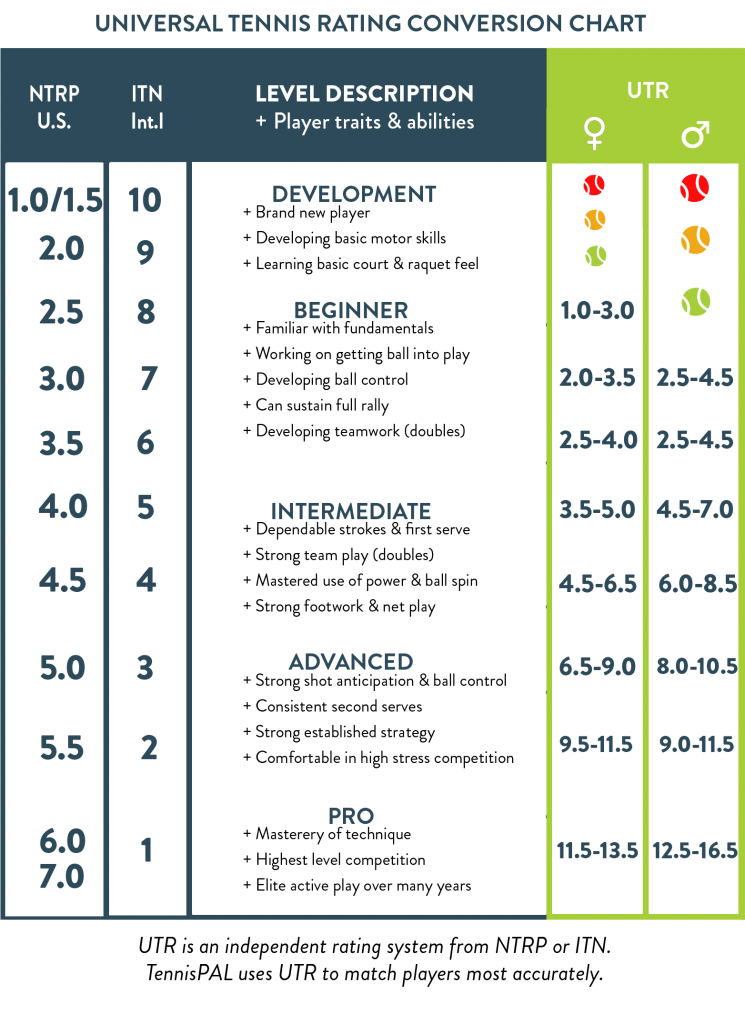
NTRP-ITN-UTR Rating Conversion
Who UTR Is For
When used correctly, UTR helps with:
✔ Fairer Competition
Players are grouped and matched more appropriately, reducing mismatches that frustrate both sides.
✔ Clearer Placement
Tournament directors, academies, and teams can place players where they belong right now, not where they were a year ago.
✔ Global Consistency
A junior competing in Europe and one competing in the U.S. can be compared on the same scale.
✔ Transparency for Parents
Parents who didn’t grow up in tennis finally have a reference point that makes sense.
If you're a junior player aiming for stronger competition pathways in Spain, here’s a breakdown of trusted high-performance academy environments.
What UTR Is Not
This part matters.
UTR is not:
a measure of talent
a prediction of future success
a reflection of effort or character
something to obsess over weekly
It’s a tool, not a verdict.
I’ve seen players improve dramatically while their UTR stayed flat for months—and others whose number jumped while their fundamentals lagged behind.
Development doesn’t always move in straight lines.

How UTR Is Calculated (Plain Language)
You don’t need to understand the algorithm to use UTR well.
At a basic level, your rating is influenced by:
who you played
how strong they were
how competitive the match was (games won)
Recent matches matter more than old ones.
Playing regularly gives a clearer picture than playing occasionally.
That’s it.
How Parents Should Use UTR
For parents, UTR is most useful as a navigation tool.
It helps you:
understand where your child fits competitively
evaluate tournament levels
ask better questions of coaches and academies
It should not become:
a weekly performance scorecard
a source of comparison with other kids
a measure of parenting success
Tennis development is a long game.
How Adults Can Use UTR (Very Effectively)
This applies to juniors and adults alike.
UTR tends to improve when players focus on:
Playing regularly
Competing at appropriate levels
Staying engaged even in tough matches
Improving fundamentals, not gaming the system
Ironically, the players who obsess the least often improve the most.
For adult club players, UTR can be useful — but match confidence and tactical clarity matter just as much. Here’s how we structure small-group coaching weeks in Spain for recreational players who want their game to hold up under pressure.
Final Thought
UTR has helped modernize competitive matchplay in a big way.
It brings structure to a global sport and helps players find their place more easily. But like any system, it works best when it’s used with perspective.
The goal isn’t a number.
The goal is better tennis, better matches, and long-term enjoyment of the game.
When you understand that, UTR becomes helpful instead of heavy.
With love from Mallorca~