
The Perfect Adult Beginner Forehand: Learn This First If You Want to Rally
The adult beginner forehand (what actually matters)
There are three strokes every beginner needs to play tennis: the forehand, the backhand, and the serve.
But let’s be honest — the forehand is the one that hooks you.
You’ll hit it more than any other shot. It’s the stroke that decides whether you can rally, or whether tennis turns into standing around, picking up balls, and hoping the next one goes in.
From years of coaching adults — both at home and on court with me in Mallorca — I see the same frustration over and over again:
Adults aren’t lacking effort.
They’re lacking clarity.
So let’s simplify this.
Why the beginner forehand feels harder than it should
Most beginner forehand advice online is overwhelming and out of order.
Adults are told to:
Add topspin too early
Change grips before they can control the ball
Copy swings that don’t match their body or timing
That’s backwards.
As a beginner, your job is not power, spin, or style.
Your job is simple:
Get the ball over the net and inside the court — consistently enough to rally.
If you can rally six balls in a row, tennis suddenly makes sense.
The forehand grip: keep it simple
For beginners, the eastern forehand grip is the place to start.
It:
Encourages clean contact
Helps you feel the ball
Makes it easier to hit through the court instead of straight into the net
Yes, you’ll hear about semi-western grips everywhere.
That comes later — when you’re ready to add topspin.
Right now, control beats everything.
(If you haven’t already, this forehand pairs directly with the grips we covered in the Tennis Grips for Beginners post.)
If you’re completely new to tennis or just getting started, structured academy environments like the Rafa Nadal Academy can be a strong fit. Use promo code: Indietenis for our discount on your training + accommodation.
If you’re already playing matches — even if things feel inconsistent — and want to understand why your shots break down under pressure, that’s where our small-group coaching weeks in Mallorca come in.
The forehand in plain English (no tennis jargon)
Here’s all you need to focus on:
See the ball early
Turn hips & shoulders sideways towards the ball coming to you
Take the racket back early
Use your non-hitting hand to balance
Make contact out in front
Swing through and finish across your body
That’s it.
No angles. No physics lesson. No overthinking.
The most important detail adults miss: balance
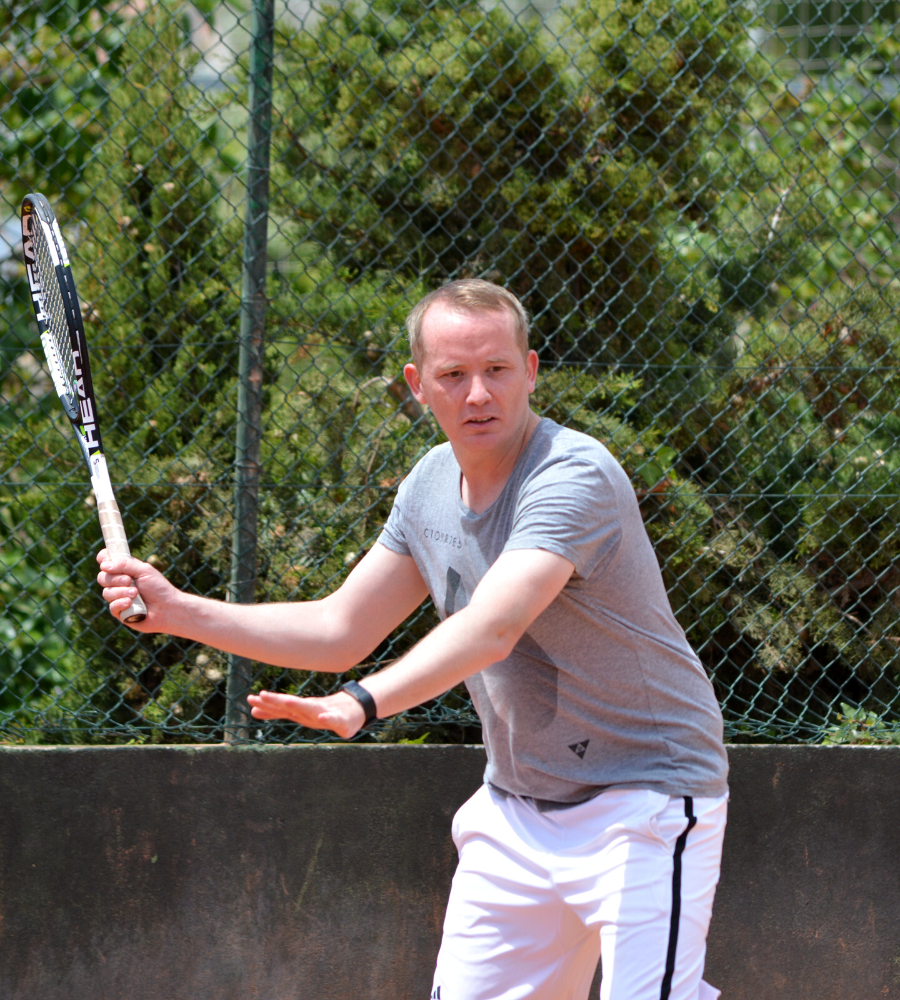
Your non-dominant hand matters more than you think.
If it hangs down by your side, your body has no reference point. Balance disappears, and timing goes with it.
When that non-hitting hand extends out in front of you:
Your body stays stable
Your contact point becomes clear
Your swing feels easier
Junior players do this naturally. Adults don’t — simply because they didn’t learn it early.
This is the single adjustment I make most often with adult players, and the one that brings the fastest improvement.

Check out his left non-hitting hand
Contact point: where good forehands are born
A good forehand is contact made out in front of your body.
Not beside you.
Not late.
Not rushed.
Your non-dominant hand shows you exactly where that contact should be.
When adults fix this one thing, rallying improves almost immediately.
If you build these fundamentals early, rallying stops feeling chaotic and starts feeling controlled
“Swing for the fences” (and why it works)

This isn’t about power.
I want your body loose.
Your arms relaxed.
Your swing long and free.
When you swing through the ball — imagining the fence on the other side of the court — your body does what it’s designed to do.
Tension disappears.
The ball travels deeper.
Your forehand starts to feel natural.
Depth matters more than pace at this stage. Deep balls give you time. Time gives you confidence.
The finish (don’t obsess over it)

After contact, let the racket finish naturally across your body.
You don’t need to exaggerate it.
You don’t need to wrap it around your neck.
You just need a relaxed, complete motion that doesn’t strain your wrist or shoulder.
As always: less is more.
Why group lessons often stall beginner forehands
This is where many adult beginners get stuck.
Group lessons are fun and social, but:
There’s limited individual feedback
Grip and contact issues go unnoticed
Bad habits linger too long
That’s why true beginner group camps are rare.
One of the places that runs them consistently - year round is Rafa Nadal Academy, where beginners can be on court in larger groups.
(You can use the promo code IndieTenis for up to 15% off any training program or accommodation.)
A faster option some adults choose
Some adults decide they don’t want to stay stuck in the beginner phase for long.
That’s where private coaching changes everything.
I offer a 10-hour intensive beginner private package in Mallorca (€947), available year-round on clay courts — the best surface to learn on because of its slower pace.
It’s not a camp.
It’s focused, personal coaching — and you still get a real holiday while you’re at it.
It’s simply an option for adults who already know:
“I like tennis. I just want to get competent faster.”
With love from Mallorca~