
The Adult Beginner Serve: Everything That's Actually Going Wrong

The serve is the shot adult beginners dread most. And it's usually not one thing — it's a cascade. One problem leads to the next, and by the time the ball leaves your hand, you were already in trouble two steps back.
I see this every camp. Players who rally reasonably well, who have decent groundstrokes, and who completely fall apart the moment they step up to the baseline to serve. The frustration is real. But the good news is that every single problem here is fixable — if you know what you're actually looking at.
Let's go through it.
New to tennis entirely? Start with our free adult beginner video course before working on volleys.
1. The Wrong Grip — And Where Your Hand Sits on the Handle
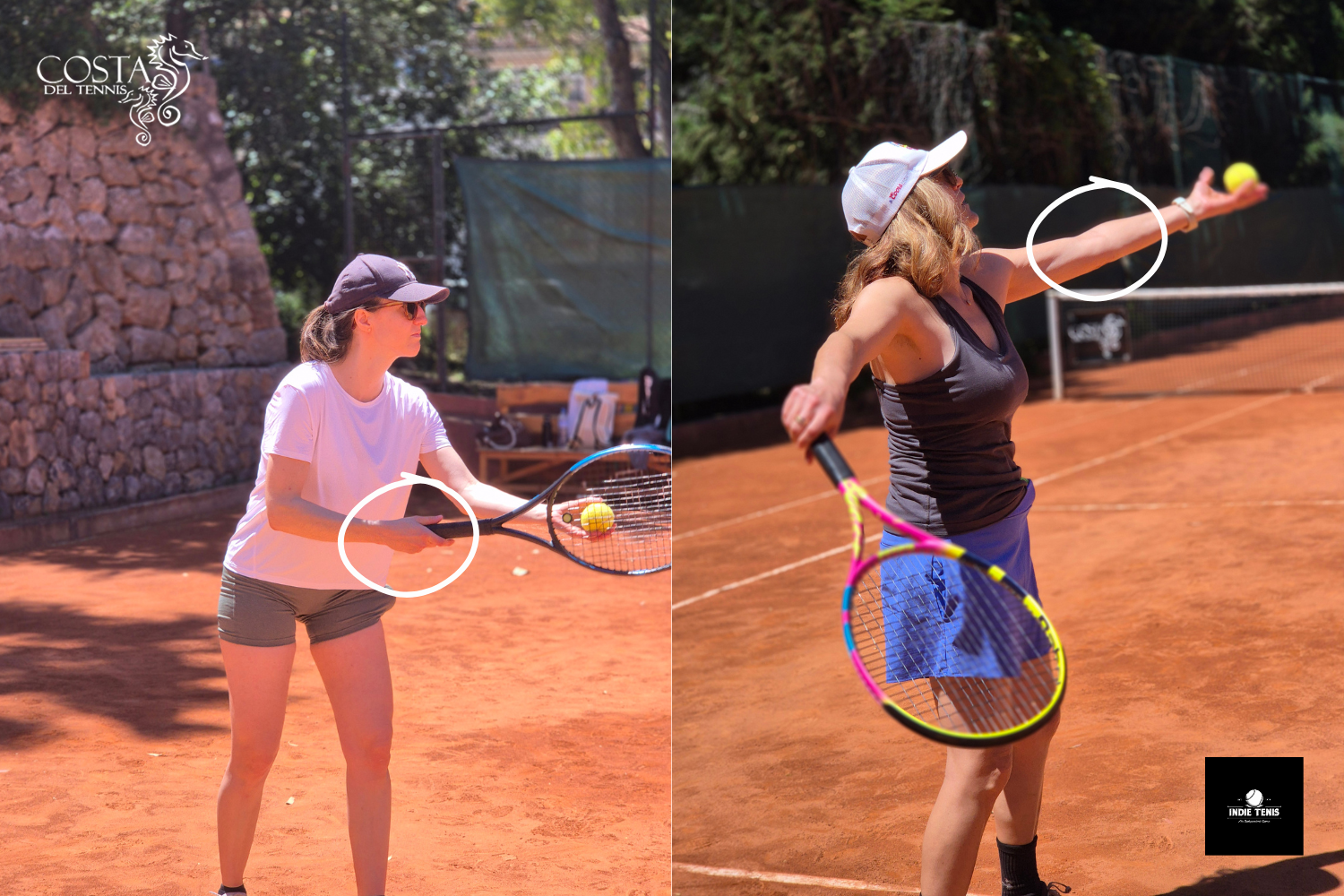
This is something I'm seeing a lot. And we're not even talking about playing grips here — we're talking about something more basic: where your hand sits on the handle.
Your hand belongs at the bottom of the handle. Not a few inches up toward the middle — at the bottom. Little kids hold the racket high because it's heavy and they can't control it. Adults don't have that problem, and holding high is costing you the most important thing the serve needs: wrist movement.
On the serve, you need as much wrist as the shot can give you. Holding your hand high and gripping tightly kills that possibility before you've even started your motion. Place the palm of your hand slightly off the bottom of the handle, and hold the racket as loosely as you can manage.
Without wrist pronation — that snap at the top — hitting over the ball to bring it down into the box becomes nearly impossible. Your shoulder, arm, and hand all need to be loose. When nerves come in, fear tightens everything up. Try to notice that and let it go. A loose grip is not optional on the serve. It's the foundation.
2. Hitting Any Toss — No Discipline, No Standard
I can read a player's eyes during toss practice. After about ten repetitions, something shifts. OK Rhonda, I've done it now — can I just hit? But the ball is landing to the side, or behind them, or they're literally walking forward to reach it.
The toss gets dismissed. How hard can it be — you're just throwing a ball up?
Juniors and professionals know exactly what it takes to place that ball in the same spot reliably, at the right height, in front of the body. It takes years of practice. Not magic. Not talent. Repetition and patience.
The toss arm needs to release the ball out in front of you — not to the side, not behind your head. Until that release is consistently forward and up, nothing else in the serve can work the way it needs to. You can practice the toss anywhere. At home. In a hotel room. Without a racket. But it won't fix itself after a few tries on court, and it won't wait until you feel ready to take it seriously.
3. Fear in the Toss Arm — Not Extending Fully
In the clip above, you can see exactly what I mean. There's a hesitation — a pulling back — right before the toss reaches its full height. The player wants the serve to go in, so they play it safe. But playing it safe on the toss is what makes it go wrong.
A full extension of the toss arm upward is not optional. The ball needs to go up — genuinely up — so that your hitting arm has time and space to accelerate and make contact at full reach. Too short a toss forces you to rush, crunch, and guess. You lose the timing before the racket even starts moving. I love a shorter toss myself it’s easier to control but it must be high enough to reach for.
Extend the arm fully. Trust the height. And let the racket fully finish across the body!
4. Not Understanding Forward Momentum — The Body Stays Back
So much of this connects back to the toss position. When the ball goes up in front of you — genuinely in front — your body naturally wants to move toward it. That forward momentum is exactly what the serve needs.
The whole motion should carry you across the baseline after contact. You toss forward, you swing forward, you land forward. The weight transfers through the shot, not away from it.
But when players are afraid — afraid of missing, afraid of the pace, afraid of committing — they hold back. The body falls back instead of forwards. The arm does all the work and there's nothing behind it.
Swing freely. Swing with as much speed as you can. If you miss, that's information — you'll know what to adjust and by how much. Without the mistakes, you have nothing to work with. The swing has to come first. Trust it.
5. Swinging Slowly — The "Careful" Serve That Always Fails
This one is counterintuitive, and I understand why players do it. You want the ball to go in. So you slow everything down and try to guide it. It feels responsible. It feels controlled. {Refer to that video clip above again}
It doesn't work.
A slow swing on the serve produces a short ball that sits up and invites your opponent to the net. That's the last place you want them. A slow swing also removes the spin and trajectory that bring the ball over the net and down into the box — which means you need to hit lower over the net, which means more errors, not fewer.
The sensation you're looking for is throwing the racket forward over the net. Fast. Committed. Like you mean it.
Think about driving on a highway at half the speed limit. Everyone behind you is frustrated and you're a hazard. The serve is the same — it needs to travel at pace to behave properly. Swing fast, aim deep, then adjust from there. You cannot adjust a serve you're too afraid to hit.
6. Not Understanding Contact — Up, Over, and On Top
This is the part that confuses most beginners, because it sounds contradictory.
Contact on the serve happens in two movements that work together. First, you drive the racket up under the ball to generate the lift that gets it over the net. Then, at the moment of contact, you hit down and over the top of the ball — the pronation — which is what brings the ball forward and down into the service box.
Without both, you either hit a flat ball that goes into the net, or a loopy ball that floats long. The up-and-over combination is what makes a serve land where it's supposed to.
The wrist does the work here — which is why the grip matters, why looseness matters, and why all of these points connect. Arm extends up. Contact on top of the ball. Racket pulls across the body. One motion.
7. No Recovery — The Serve Ends at Contact
After you serve, where are you?
If the answer is still at the baseline, flat-footed, watching the ball — you're already in trouble. No man's land is a dangerous place to be standing when the return comes back.
Every shot in tennis has a recovery built into it. The serve is no different. After contact, the momentum of the motion carries you forward and across the baseline. From there, you need to actively push back behind the line and reset — balanced, ready, watching the returner.
It sounds like a small thing. It is not. The recovery is part of the shot. Players who are afraid during the serve tend to freeze at contact, because the fear has taken up all the space in their head. But the point isn't over. It's just starting.
Finish the serve. Land across. Recover. Move.
Where to Go From Here
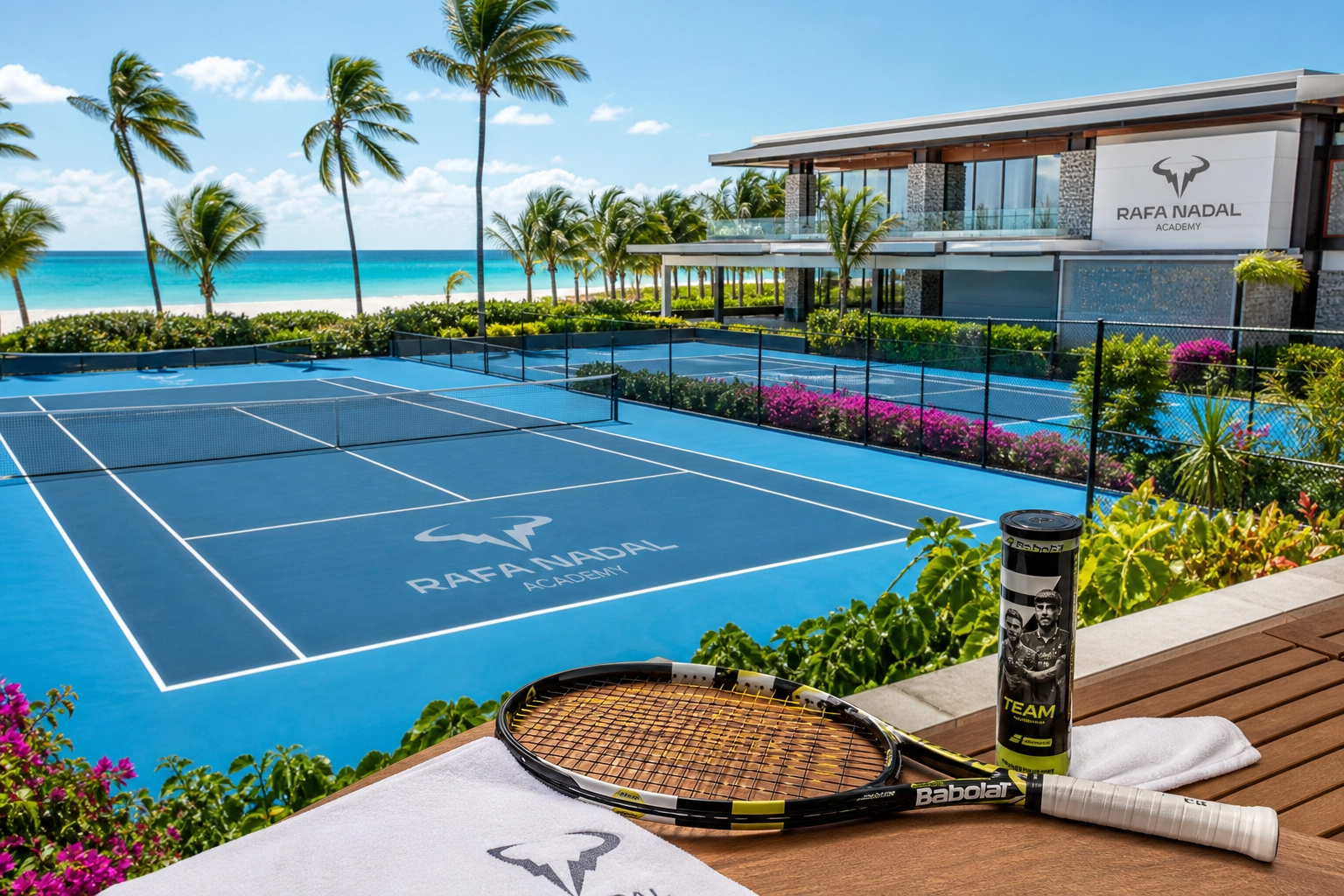
If you're at this stage — working through the basics of the serve, starting to make sense of the motion — and you want real coaching in a structured environment, these are two options worth knowing about.
The Rafa Nadal Tennis Center in Cancún and the Dominican Republic offers coached programs designed specifically for adult recreational players at all levels, including beginners. The methodology comes directly from the Rafa Nadal Academy in Mallorca, delivered in a relaxed, resort-style environment with excellent facilities. You can read more about it here. It's not high-performance intensity — it's purposeful, well-coached, and structured around actually improving. Use my code INDIETENIS when enquiring for an exclusive partner discount.
If you're further along — you've got a serve in play, you're rallying consistently, and you want to take a week in Spain to put it all together in a small coaching group — that's where Costa del Tennis comes in. My adult camps in Mallorca and Andalucía are for advanced beginners through high club intermediate players who want real improvement in a high-quality, relaxed setting. Find out more here →
The serve takes time. But it's also one of the most satisfying shots in the game once it starts clicking. Give it the attention it deserves — and don't rush past the toss.
Rhonda Costa is the founder of Costa del Tennis and Indie Tenis. She runs boutique adult tennis coaching camps in Mallorca. Marbella and Andalucía, and works as an agent partner of the Rafa Nadal Academy.